


SFP Module LX/LH 10 km SM, 2 km MM, 1310 nm, Duplex LC, 1.25 Gbps, DDM, Cisco
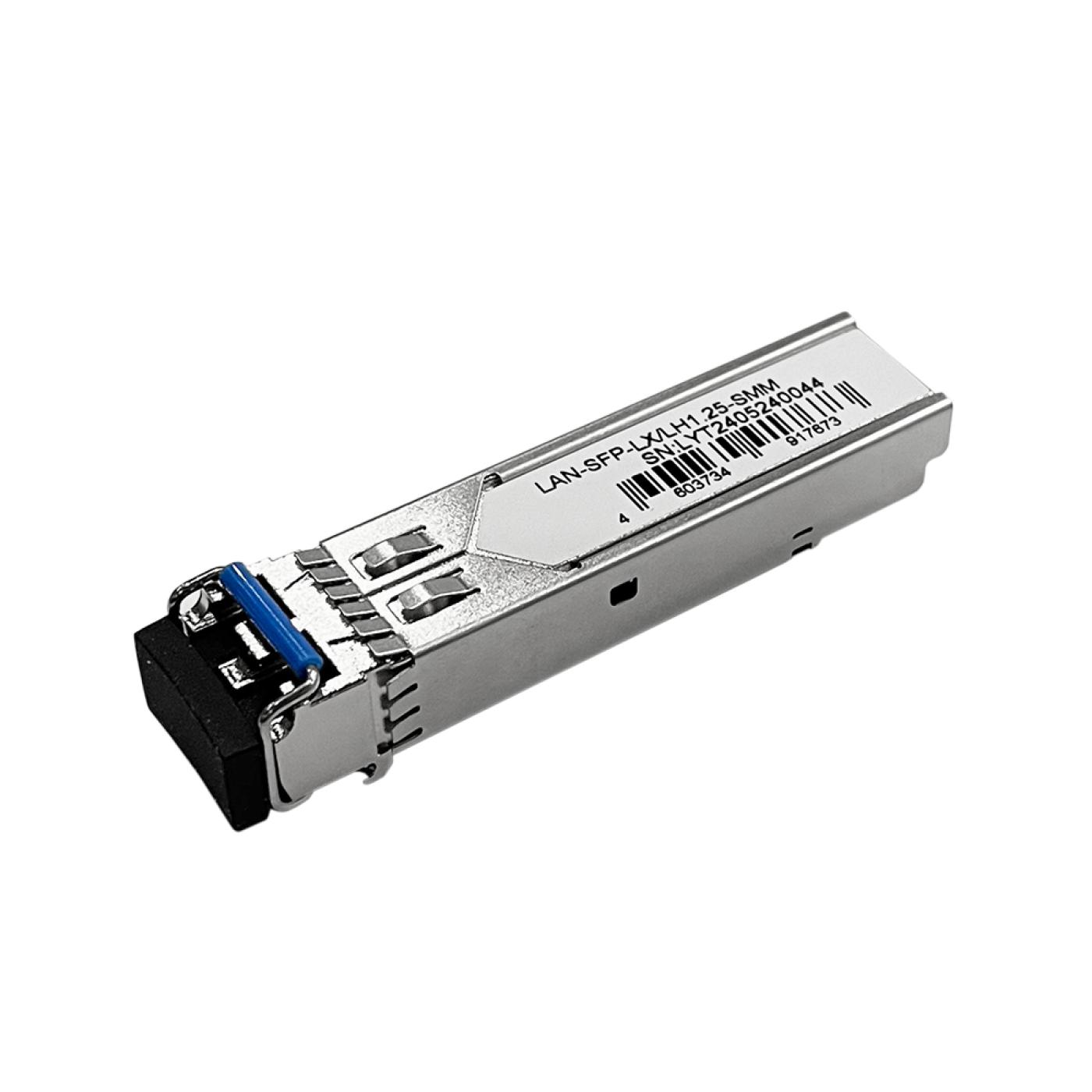
Single-mode and multi-mode fiber optic SFP transceiver module for 1G Ethernet, compliant with 1000Base-LX standard. Designed for use with single-mode (SM) and multi-mode (MM) fiber, with a maximum transmission distance of 10 km over single-mode fiber and 2 km over multi-mode fiber. Features duplex LC connectors, transmit wavelength of 1310 nm.
SFP modules include Digital Diagnostic Monitoring (DDM) for real-time monitoring of module performance parameters.
Module firmware supports interoperability with equipment from various brands, depending on the selected firmware version.
Key Features:
- Up to 1.25 Gbps data rate
- Duplex LC connector
- Transmission distance up to 10 km over SM 9/125 µm fiber and up to 2 km over MM fiber
- FP laser at 1310 nm
- 3.3 V power supply
- EMI-shielded metal housing
- Low heat dissipation
- Commercial temperature range: 0°C to 70°C
- RoHS compliant, lead-free
Applications:
- 1.25 Gbps Ethernet 1000Base-LX
- 1.06 Gbps Fibre Channel
- Various optical connections
Frequently Asked Questions
What is the LAN-SFP-LX/LH1.25-SMM optical module used for?
LAN-SFP-LX/LH1.25-SMM is a dual-fiber optical module in the SFP (small form-factor pluggable) format for Gigabit Ethernet under the 1000BASE-LX standard. It works over single-mode fiber (SM) up to 10 km and over multimode fiber (MM) up to 2 km. The transmitter wavelength is 1310 nm, the connector is a duplex LC (Lucent Connector) and the speed is up to 1.25 Gbit/s.
Which fiber should I use with this module: single-mode or multimode?
For links up to 10 km use 9/125 µm single-mode fiber; for links up to 2 km multimode fiber is acceptable. The patch cord type must match the fiber of the link. For 1000BASE-LX over multimode fiber, equipment manufacturers recommend a mode-conditioning patch cord, so if a multimode link has problems, check this requirement in the equipment documentation.
Which module should be installed at the other end of the link?
The module works with a 1000BASE-LX module at 1310 nm, for example another LAN-SFP-LX/LH1.25-SMM or a LAN-SFP-LX1.25-SM. Modules of different standards or wavelengths cannot be paired. Both ports must be set to 1 Gbit/s.
Will the module work with my switch? Why might the switch not recognize it?
The module is supplied in a Cisco-compatible version; the module firmware supports equipment from different vendors depending on the firmware version selected. When ordering, state the make and model of your switch so that the suitable firmware can be chosen. If the switch reports an unsupported transceiver, the vendor code in the module has not been accepted by the equipment: check the module firmware version and the transceiver-check settings on the switch, and contact LANMASTER technical support if needed.
Can the module be installed and removed while the equipment is powered? What is DDM?
Yes, the module can be installed and removed without powering off the equipment. Before removal, disconnect the patch cord and fit the protective cap on the optical port. The module supports digital diagnostic monitoring (DDM): in the switch management interface you can check temperature, supply voltage, laser bias current, and transmit and receive power in real time. Do not look into the fiber end or into the optical port of a powered module — laser light can damage the eyes.
What should I do if the link does not come up?
Check in order: whether the standard and wavelength of the modules at both ends match; whether the fiber type of the patch cord and the link are the same; whether transmit (Tx) and receive (Rx) are swapped — if there is no link, swap the two connectors of the duplex patch cord at one end. Then inspect and clean the connector end faces and check the receive power through digital diagnostic monitoring (DDM).
How do I clean the module port and the patch cord?
Inspect the connector end face before each connection and clean it if dirty. For LC (Lucent Connector) connectors (1.25 mm ferrule) the LAN-FT-CL/OK1 cleaning tool is suitable. Keep unused module ports and patch cord connectors closed with protective caps.
How should I use and store the module?
Operate the module at 0 to +70 °C; the 3.3 V supply is provided by the equipment port. The module housing is metal. Before installation, store the module in its antistatic packaging with the protective cap in the optical port.