


GYXTW type armored cable, outdoor, PE jacket
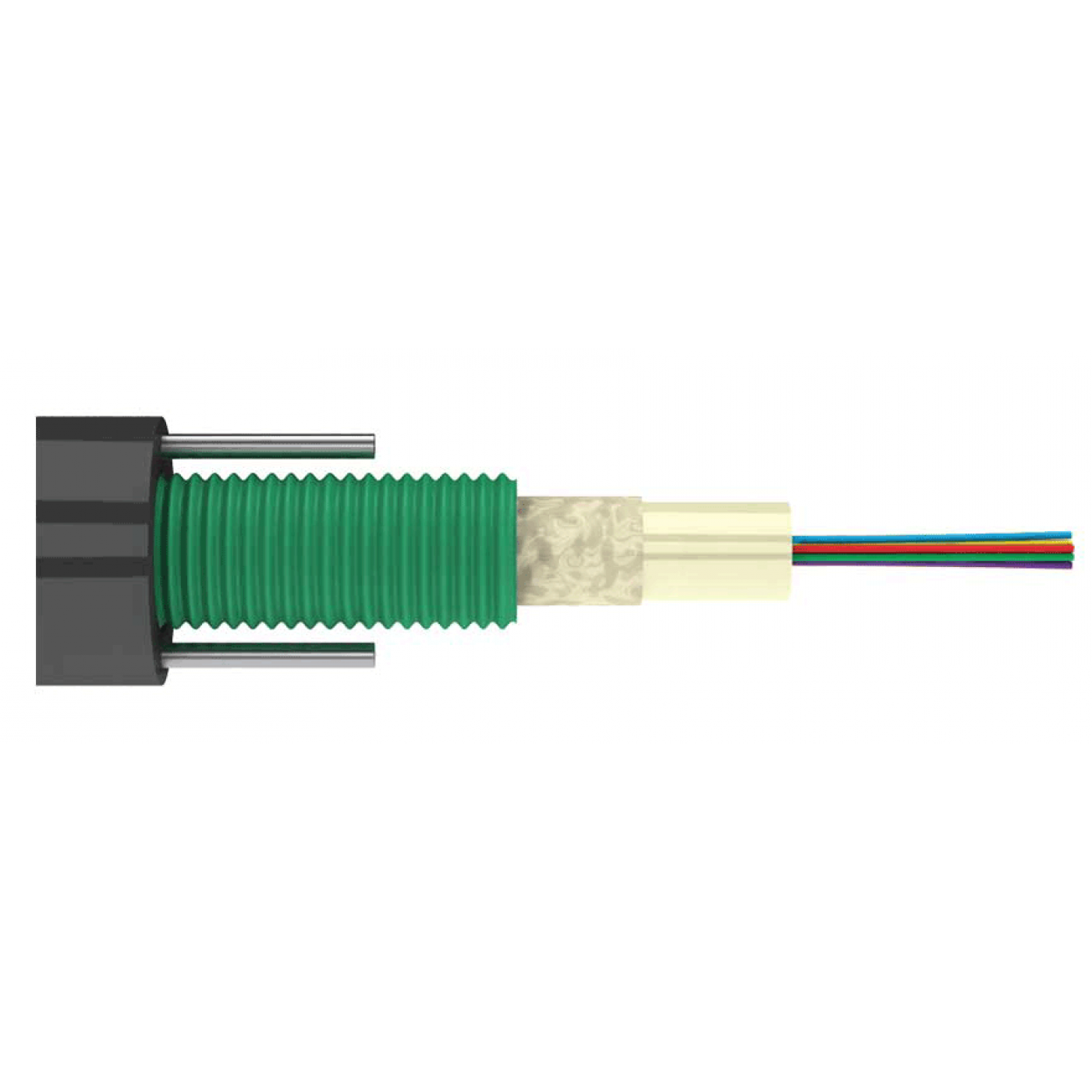
Application: Outdoor armored fiber optic cable for installation in cable ducts, pipes, trays, tunnels, collectors, over bridges and overpasses, in the ground and between buildings.
Design: Central loose-tube optical module with hydrophobic filling compound, corrugated steel tape armor and a black UV-resistant polyethylene jacket.
Fiber identification: standard color coding is used. Check the current product datasheet for the complete color table, dimensions and mechanical parameters.
Operating conditions: see the current product datasheet for temperature range, tensile load, crush resistance and minimum bend radius.
Frequently Asked Questions
What is the LAN-OFC-GYXTWxxyyk cable used for?
Armored cable of the GYXTW type: an optical module with loosely laid fibers, hydrophobic gel, corrugated steel tape armor, two diametrically placed steel wires as strength members and a polyethylene jacket. Version 1 may have a water-blocking tape over the module.
Where can this cable be installed?
The cable is intended for installation in cable ducts, pipes, trays, blocks, tunnels, collectors and on bridges and overpasses.
How is the part number decoded and which versions are in the series?
In LAN-OFC-GYXTWxxyyk, xx is the fiber count, yy is the fiber type and k is the construction type (1 or 2). The maximum fiber count in the cable is 24. The series includes versions with 4, 8, 12, 16, 24 fibers. Fiber types: S2 — G.652D single-mode fiber; SU — G.652D single-mode fiber with low bend loss (G.657.A1); M2 — 50/125 µm multimode fiber (OM2); M3 — 50/125 µm multimode fiber (OM3). Jacket: PE (polyethylene) — polyethylene jacket. Choose the version by fiber count, fiber type and installation conditions.
What temperatures and forces are permitted during installation and operation?
For reliability use the narrower range given for the different construction types: operating temperature −40 to +70 °C and installation temperature −20 to +50 °C. The short-term permitted tensile force is 1500 N and the long-term force is 600 N.
What is the minimum bend radius of the cable?
The minimum bend radius is at least 15 cable diameters. Use the stricter value for both construction types.
How are fibers identified by color?
Fibers are identified by color code: 1 — blue, 2 — orange, 3 — green, 4 — brown, 5 — gray, 6 — white, 7 — red, 8 — black, 9 — yellow, 10 — violet, 11 — pink, 12 — turquoise (aqua). From fiber 13 onward the same colors are used with an additional mark or ring.
What should I do with the hydrophobic gel when preparing the cable?
The free space in the optical module and under the armor is filled with hydrophobic gel. Before termination, remove the gel from the fibers with special lint-free wipes and a cleaner recommended by the splicing equipment manufacturer, and only then strip the fiber coating and cleave. Gel on the fiber impairs cleaving, splicing and cleaning.
Does a cable with metal elements need to be grounded?
If the cable contains metal elements (steel armor, steel wire or messenger), provide for their grounding and termination at the building entry according to the project and applicable standards. Metal elements must not be left ungrounded at the building entry or in areas exposed to lightning and induced currents.
What tools prepare the cable and how are the fibers terminated?
Remove the outer jacket and armor without damaging the central optical module and open the module. Secure the metal armor elements in the closure or frame and ground them according to the project. Then strip the 900 µm buffer and 250 µm acrylate coating from the fiber with a stripper such as LAN-FT-STR/OFC, clean the fiber and cleave it. Fibers are terminated with pigtails (fusion splice or the LAN-FMS mechanical splice) or with field-installable connectors.
Product Codes (12)
-
Corrugated steel tape armored fiber optic cable, GYXTW, 2.7 kN, PE, outdoor, 4 fibers, OM2
-
Corrugated steel tape armored fiber optic cable, GYXTW, 2.7 kN, PE, outdoor, 4 fibers, OM3
-
Corrugated steel tape armored fiber optic cable, GYXTW, 2.7 kN, PE, outdoor, 8 fibers, OS2 Ultra
-
Corrugated steel tape armored fiber optic cable, GYXTW, 2.7 kN, PE, outdoor, 8 fibers, OM2
-
Corrugated steel tape armored fiber optic cable, GYXTW, 2.7 kN, PE, outdoor, 8 fibers, OM3
-
Corrugated steel tape armored fiber optic cable, GYXTW, 2.7 kN, PE, outdoor, 16 fibers, OS2 Ultra
-
Corrugated steel tape armored fiber optic cable, GYXTW, 2.7 kN, PE, outdoor, 16 fibers, OM3
-
Corrugated steel tape armored fiber optic cable, GYXTW, 2.7 kN, PE, outdoor, 24 fibers, OS2 Ultra