


Indoor/Outdoor FTTH cable
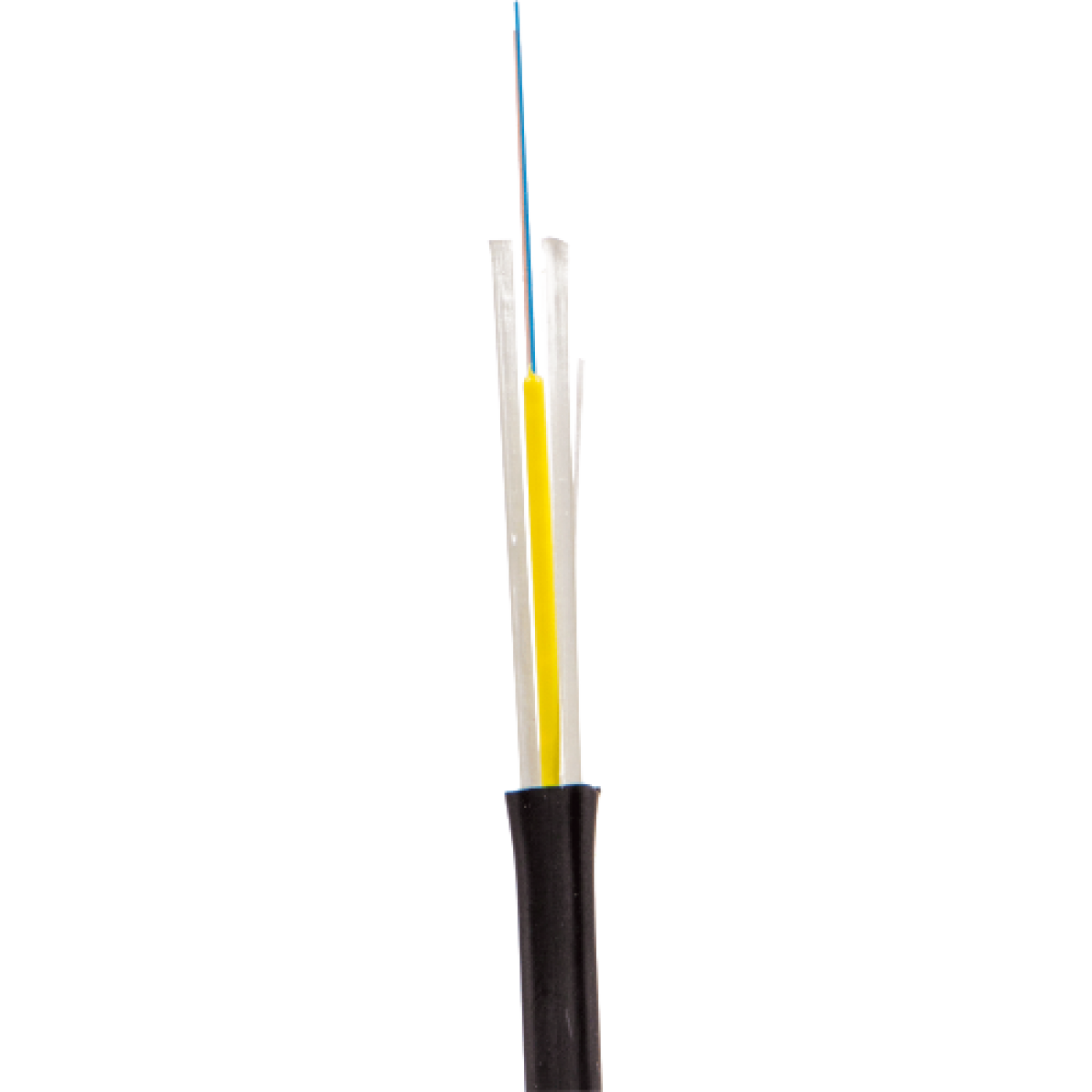
Used as a distribution cable for suspension on the utility poles, electricity pylons, between buildings, and for cabling inside buildings, in cable ducts, pipes, also for outdoor cabling along the external facades of buildings.
The cable has loose tube (? Or tight tube) optical fibers. FRP rods are used as strength members. Steel wire is used as a messenger. Fibers, the strength members, and the messenger are covered with overall jacket. The cable jacket is made of a flame retardant, halogen-free, low-smoke polymer composition.
The cable jacket color is black.
The maximum possible count of optical fibers in the cable is 8.
Design

Color identification of tight buffer optical fibers:
| № | Fibers 1-8 |
| 1 | Blue |
| 2 | Orange |
| 3 | Green |
| 4 | Brown |
| 5 | Grey |
| 6 | White |
| 7 | Red |
| 8 | Black |
Weight and dimensions
Fiber count in the cable |
Up to 4 |
Up to 8 |
Cable dimensions, mm |
2,0 x 5,2 |
2,1 x 5,6 |
Cable weight, kg/km |
19,6 |
21,0 |
Minimum bend radius, mm |
20 |
21 |
Operating conditions
Operating Temperature |
-50°C…+70°C |
Installation Temperature |
-10°C…+50°C |
Storage Temperature |
-50°C…+50°C |
Minimum Bend Radius |
At least 10 cable diameters |
Lifetime |
25 years |
Physical specifications
Optical cable is resistant to the following impacts
Impact type |
Nominal value |
Criteria for evaluation |
|---|---|---|
Installation pulling tension (IEC 794-1-93 E1 test procedure) |
730 N |
Δα* ≤ 0,05 dB no damage |
Crush resistance |
200 N/cm |
|
Dynamic bending stresses |
20 cycles at an angle ±90° |
|
Axial twisting stresses |
10 cycles at an angle of ± 360 ° at a length of 4 m |
|
Impact (IEC 794-1-93 E4 test procedure) |
Impact energy is 1 J |
|
Climatic impact* |
Temperature range from |
Δα ≤ 0,05 dB/km |
* - increase in attenuation of an optical fiber in a cable at specific wavelengths.
Applicable optical fibers
SU |
Single-mode fiber with extended operating wavelength and reduced attenuation and low bending loss (ITU G.652D+G.657.A1 recommendation) |
S2 |
Single-mode fiber with an extended bandwidth of operating wavelengths (ITU-T G.652D recommendation) |
S5 |
Single-mode positive non-zero dispersion shifted fiber (ITU-T G.655 recommendation) |
S7 |
Single-mode with low bending loss (ITU-T G.657 recommendation) |
M1 |
Multi-mode with core to cladding ratio 62,5/125 μm (IEC 60793-2-10 A1b type recommendation) |
M2 |
Multi-mode with core to cladding ratio 50/125 μm (ITU-T G.651 recommendation and IEC 60793-2-10 type A1a.1 requirements) |
M3 |
Multi-mode with low bending loss and core to cladding ratio 50/125 μm (ITU-T G.651 recommendation and IEC 60793-2-10 A1a.2 type requirements) |
M4 |
Single-mode fiber with extended operating wavelength and reduced attenuation and low bending loss (ITU G.652D+G.657.A1 recommendation) |
Frequently Asked Questions
What is the LAN-OFC-FUFx-yy-LS cable used for?
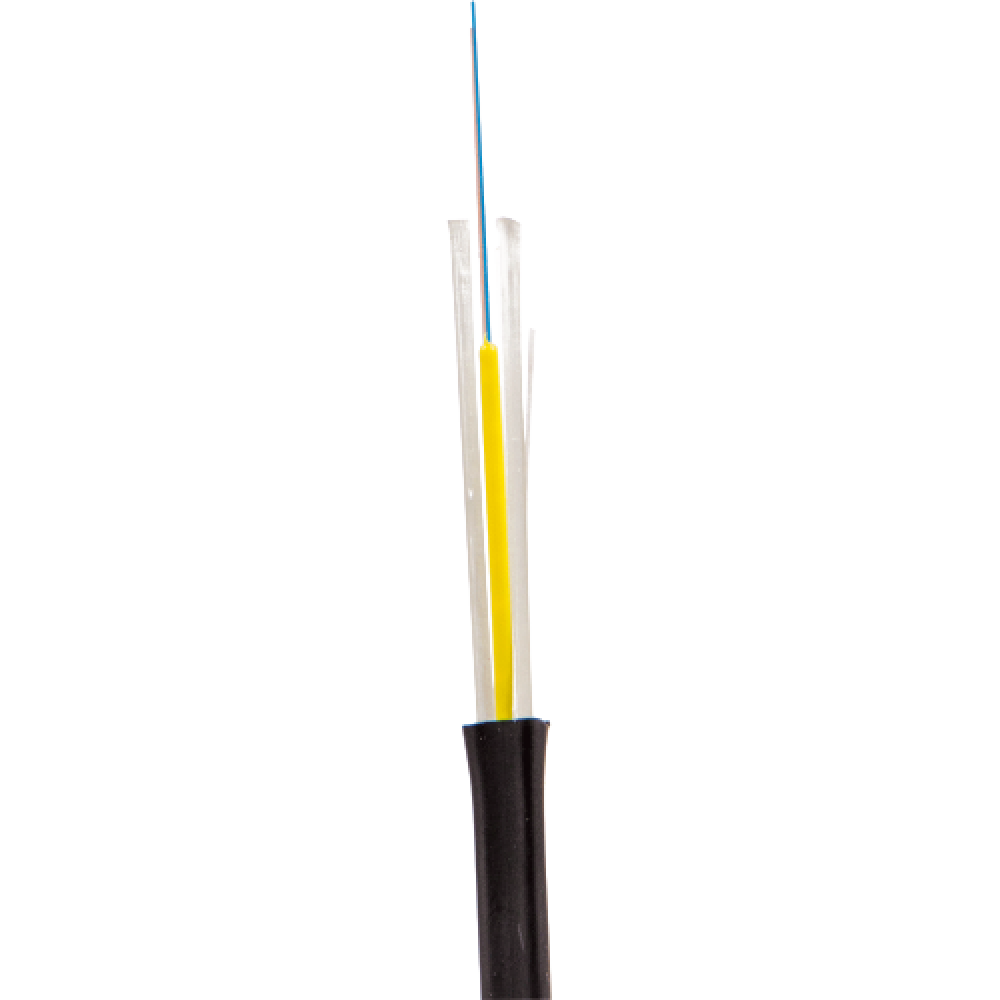
Universal FTTH (Fiber To The Home) subscriber cable, small, light and strong. Two strength members protect against mechanical stress; the jacket is black, with reduced smoke and gas emission, halogen-free and UV-resistant. Service life is 25 years.
Where can this cable be installed?
The cable is intended for network distribution in private houses and for installation inside buildings, in cable trays and ducts. It has no suspension element, so for spans between poles choose the version with a suspension element.
How is the part number decoded and which versions are in the series?
In LAN-OFC-FUFx-yy-LS, x is the fiber count, yy is the fiber type and LS (Low Smoke) is the nг(А)-LS jacket. The series includes versions with 1, 2, 4 fibers. Fiber types: S7 — G.657 single-mode fiber with low bend loss. Jacket: LS — nг(А)-LS jacket: does not propagate flame in bunched installation (category A), reduced smoke and gas emission. Choose the version by fiber count, fiber type and installation conditions.
What temperatures and forces are permitted during installation and operation?
Operating temperature is −40 to +70 °C, installation temperature is −20 to +60 °C, and transport and storage temperature is −40 to +70 °C. The permitted tensile force is 80 N short-term and 40 N long-term.
What is the minimum bend radius of the cable?
The minimum bend radius is at least 10 cable diameters. Avoid sharp bends when routing in ducts and at corners.
How are fibers identified by color?
Fibers are identified by color code: 1 — blue, 2 — orange, 3 — green, 4 — brown.
What tools prepare the cable and how are the fibers terminated?
For stripping the jacket of flat drop cable the LAN-FT-STR/FTTH tool is suitable; check the cable against the tool profile. Then strip the 900 µm buffer and 250 µm acrylate coating from the fiber with a stripper such as LAN-FT-STR/OFC, clean the fiber and cleave it. Fibers are terminated with pigtails (fusion splice or the LAN-FMS mechanical splice) or with field-installable connectors.