


Indoor fiber optic cable, LSZH, micro-modules
Application:
Indoor fiber optic distribution cable for installation inside buildings, in cable trays, cable ducts, pipes and tunnels.
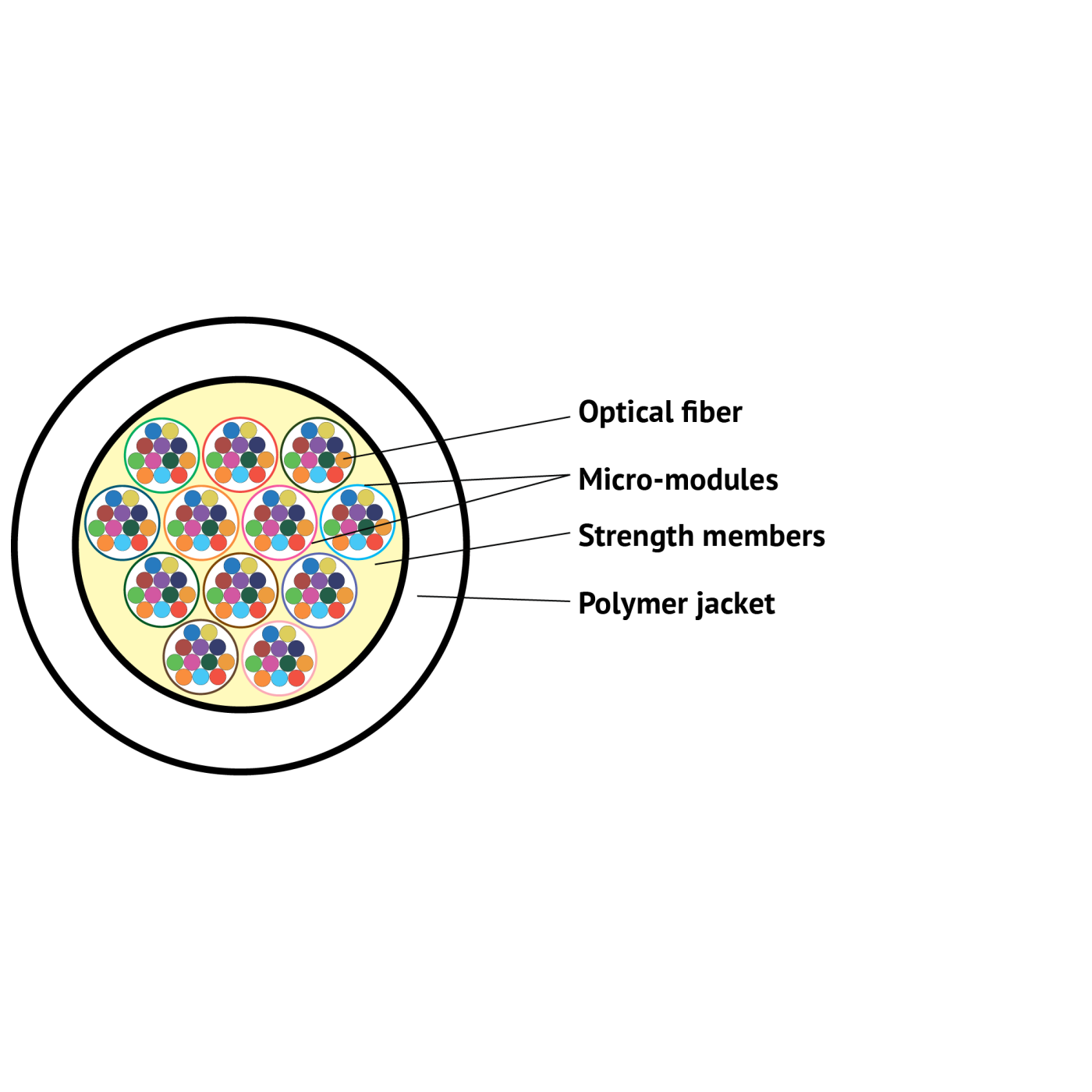
Design: micro-module cable with optical fibers, aramid yarn strength members and a flame-retardant low-smoke halogen-free jacket.
Jacket colors: yellow for OS2 single-mode fiber, orange for OM1/OM2 multimode fiber, aqua for OM3 multimode fiber and pink for OM4 multimode fiber.
The maximum fiber count is 288 fibers.
Fiber and micro-module color identification: standard fiber and module color coding is used. Check the current product datasheet for the complete color table, cable dimensions and mechanical parameters.
Frequently Asked Questions
What is the LAN-OFC-DIMxx-yy-HF cable used for?
Indoor distribution optical cable with a bundle of micromodules, aramid strength yarns and an nг(А)-HF jacket. The jacket color shows the fiber type: yellow for OS2, orange for OM1/OM2, aqua for OM3 and pink for OM4.
Where can this cable be installed?
The cable is intended for indoor installation as a distribution cable.
How is the part number decoded and which versions are in the series?
In LAN-OFC-DIMxx-yy-HF, xx is the fiber count, yy is the fiber type and HF (Halogen Free) is the nг(А)-HF jacket. The maximum fiber count in the cable is 288. The series includes versions with 8, 12 fibers. Fiber types: S2 — G.652D single-mode fiber; M2 — 50/125 µm multimode fiber (OM2); M3 — 50/125 µm multimode fiber (OM3); M4 — 50/125 µm multimode fiber (OM4). Jacket: HF — nг(А)-HF jacket: does not propagate flame in bunched installation (category A), halogen-free, low smoke. Choose the version by fiber count, fiber type and installation conditions.
What temperatures and forces are permitted during installation and operation?
Operating and installation temperature is −10 to +50 °C. The short-term permitted tensile force is 800 N.
What is the minimum bend radius of the cable?
The minimum bend radius is at least 10 cable diameters. Avoid kinks in the cable at route turns and where it enters the closure or frame.
How are fibers identified by color?
Fibers are identified by color code: 1 — blue, 2 — orange, 3 — green, 4 — brown, 5 — gray, 6 — white, 7 — red, 8 — black, 9 — yellow, 10 — violet, 11 — pink, 12 — turquoise (aqua). From fiber 13 onward the same colors are used with an additional mark or ring.
What are micromodules and what are their advantages?
In this cable the fibers are grouped into compact micromodules covered with strength yarns and a jacket. The colors of micromodules and fibers encode the fiber number, so the required fiber is easy to find. Micromodules give a high fiber density in a small-diameter cable and let you open only the required micromodule.
What tools prepare the cable and how are the fibers terminated?
Remove the outer cable jacket without damaging the micromodules, trim the aramid yarns (or fiberglass strength members), open the required micromodule and take out the fibers. Then strip the 900 µm buffer and 250 µm acrylate coating from the fiber with a stripper such as LAN-FT-STR/OFC, clean the fiber and cleave it. Fibers are terminated with pigtails (fusion splice or the LAN-FMS mechanical splice) or with field-installable connectors.
Product Codes (7)
-
Indoor fiber optic distribution cable, LSZH, 12 (2x6) fibers, micro-modules, OS2
-
Indoor fiber optic distribution cable, LSZH, 12 (2x6) fibers, micro-modules, OM2
-
Indoor fiber optic distribution cable, LSZH, 12 (2x6) fibers, micro-modules, OM4