


Indoor/outdoor FTTH cable with messenger wire, LSZH jacket



Application:
Indoor/outdoor FTTH subscriber cable with small dimensions and high flexibility. It is used as a distribution cable for aerial installation on communication poles, utility poles and lighting poles, between buildings, inside buildings, in cable ducts and pipes, and along external building facades.
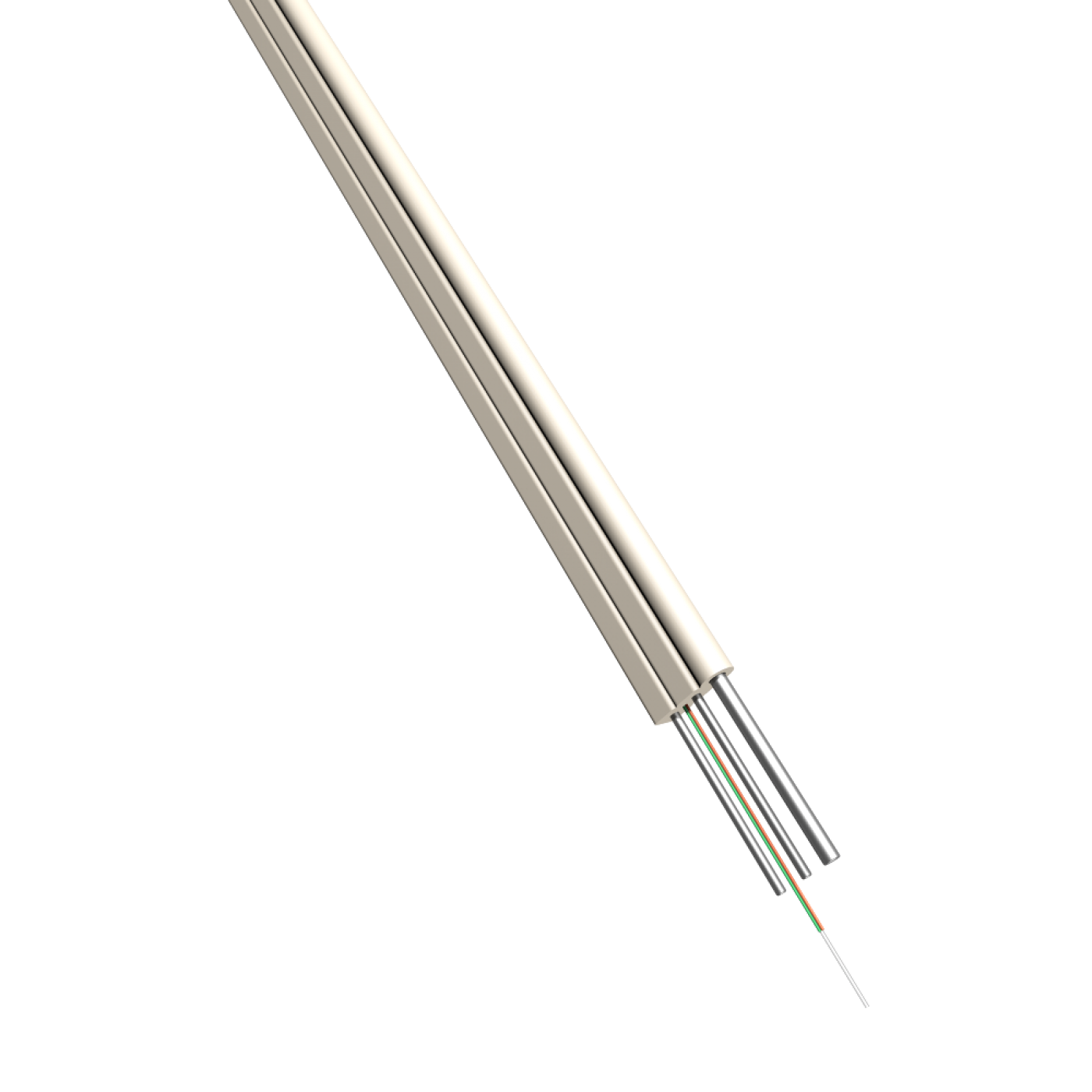
Design: flat cable with optical fibers, strength members and messenger wire under a common low-smoke halogen-free jacket.
The maximum fiber count is 8 fibers.
Weight, dimensions and operating parameters: check the current product datasheet for cable diameter, weight, tensile load, crush resistance, bend radius and temperature range.
Frequently Asked Questions
What is the TWT-OFC-FUSx-yy-LS-T cable used for?
Universal TWT subscriber cable for FTTH (Fiber To The Home) networks, small and flexible. Two steel-wire strength members protect against mechanical stress; the jacket does not propagate flame and has reduced smoke and gas emission. A steel-wire messenger is integrated with the cable in a figure-8 design.
Where can this cable be installed?
The cable is intended for aerial installation on communication and power-line poles, lighting poles and between buildings and structures, as well as for installation inside buildings, in cable ducts, pipes and on exterior facades. Secure the cable by the messenger.
How is the part number decoded and which versions are in the series?
In TWT-OFC-FUSx-yy-LS-T, x is the fiber count, yy is the fiber type and LS (Low Smoke) is the nг(А)-LS jacket, T — steel-wire messenger (figure-8 design). The maximum fiber count in the cable is 8. The series includes versions with 2, 4 fibers. Fiber types: SU — G.652D single-mode fiber with low bend loss (G.657.A1). Jacket: LS — nг(А)-LS jacket: does not propagate flame in bunched installation (category A), reduced smoke and gas emission. Choose the version by fiber count, fiber type and installation conditions.
What temperatures and forces are permitted during installation and operation?
Operating temperature is −50 to +70 °C and installation temperature is −10 to +50 °C. Attenuation of G.652D single-mode fiber: no more than 0.35 dB/km at 1310 nm and no more than 0.22 dB/km at 1550 nm.
What is the minimum bend radius of the cable?
The minimum bend radius is at least 10 cable diameters. Avoid kinks in the cable at route turns and where it enters the closure or frame.
How are fibers identified by color?
Fibers are identified by color code: 1 — blue, 2 — orange, 3 — green, 4 — brown.
Does a cable with metal elements need to be grounded?
If the cable contains metal elements (steel armor, steel wire or messenger), provide for their grounding and termination at the building entry according to the project and applicable standards. Metal elements must not be left ungrounded at the building entry or in areas exposed to lightning and induced currents.
What tools prepare the cable and how are the fibers terminated?
For stripping the jacket of flat drop cable the LAN-FT-STR/FTTH tool is suitable; check the cable against the tool profile before use. First separate the optical part from the messenger. Then strip the 900 µm buffer and 250 µm acrylate coating from the fiber with a stripper such as LAN-FT-STR/OFC, clean the fiber and cleave it. Fibers are terminated with pigtails (fusion splice or the LAN-FMS mechanical splice) or with field-installable connectors.
Product Codes (2)
-
Indoor/outdoor FTTH drop cable with messenger wire, flat, steel wire, LSZH, 2xOS2 Ultra, white
-
Indoor/outdoor FTTH drop cable with messenger wire, flat, steel wire, LSZH, 4xOS2 Ultra, white